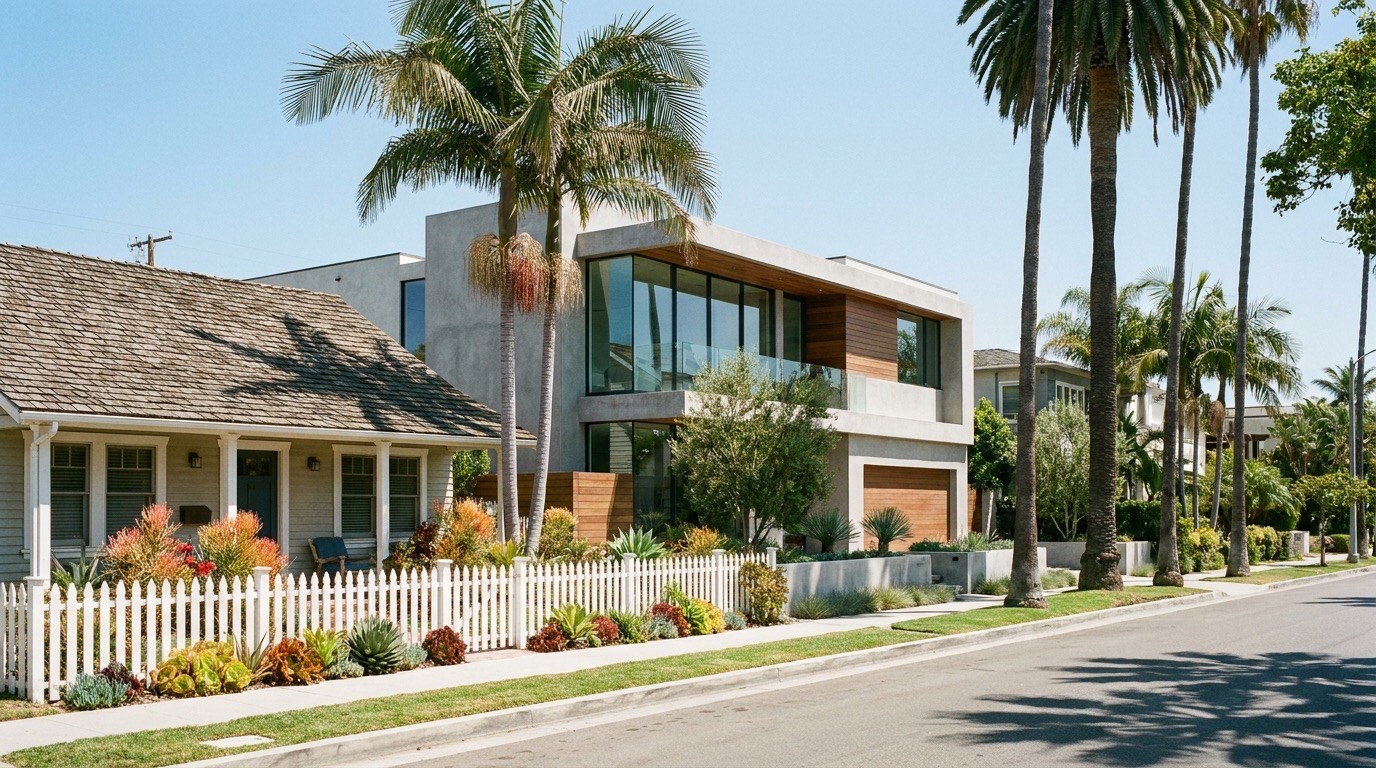
Venice’s best streets aren’t a single list, they depend heavily on what a buyer actually wants: water frontage, walkability, quiet, or proximity to the energy of the boardwalk. Here’s a general, buyer-facing overview of the neighborhood’s most commonly cited pockets, and the honest tradeoffs of each. For a fuller explanation of Venice’s overall boundaries and how its sub-areas fit together, see our breakdown of Venice’s neighborhood boundaries.
The Venice Canals: The Clearest Water-Frontage Premium
Homes directly on the Venice Canals carry a real premium tied to water frontage, a feature that doesn’t exist anywhere else in the neighborhood. The canal streets are quiet, largely pedestrian, and have a distinct residential character that draws buyers specifically looking for that setting rather than a general Venice address. It’s a smaller, more specific market than the rest of Venice, and pricing reflects that.
The Silver Triangle and the Blocks Around Abbot Kinney
The pocket of streets near Abbot Kinney is commonly referred to, informally, as the Silver Triangle, and it’s generally considered one of Venice’s more desirable residential areas thanks to its walkability to the neighborhood’s main commercial and dining strip. As with most informally named pockets, exact boundaries vary depending on who you ask, so it’s worth confirming the specific streets tied to any listing rather than assuming from the name.
Streets Directly on the Boardwalk: Energy in Exchange for Noise
Streets closest to Venice Beach and the boardwalk offer the most direct access to the neighborhood’s signature energy, and for some buyers that’s the entire point of buying in Venice. The tradeoff is real: more tourist foot traffic, more weekend noise, and a busier daily environment than almost anywhere else in the neighborhood. This is one of the clearest cases in Venice where “closest to the main attraction” and “quietest to live on” pull in opposite directions.
Quieter Inland Streets East of Lincoln
Streets further inland, generally east toward and past Lincoln Boulevard, tend to be quieter, more purely residential, and less expensive than the canal or beach-adjacent pockets. They trade some of Venice’s signature walkability and character for a calmer daily environment, which is exactly the tradeoff some buyers, particularly families, are looking to make. If a quieter version of Venice’s character is what you want, this is generally where to focus a search.
Proximity to Lincoln Boulevard Marks a Real Shift
Lincoln Boulevard functions as a rough dividing line in Venice’s character. Streets closer to the water side of Lincoln tend to carry the walkability and premium pricing associated with the neighborhood’s reputation, while streets on the other side start to feel more like a standard LA residential grid, less expensive, more car-oriented, and generally quieter. Knowing which side of that line a specific address sits on tells you a lot before you even see the house.
How to Evaluate a Street Beyond Its Reputation
General pocket reputations are a reasonable starting point, but they’re not a substitute for walking a specific street yourself. Check it on a quiet weekday morning and again on a busy weekend afternoon, look at actual parking availability, and confirm flood zone status if you’re looking at anything canal-adjacent. Two streets a few blocks apart in Venice can feel like entirely different neighborhoods, and a street’s general reputation only tells you part of that story.
If you’re trying to narrow down which specific Venice streets fit your priorities, reach out to Efrat. She serves buyers and sellers across Los Angeles, including Venice, and can walk you through the practical differences between these pockets before you commit to a search area.
