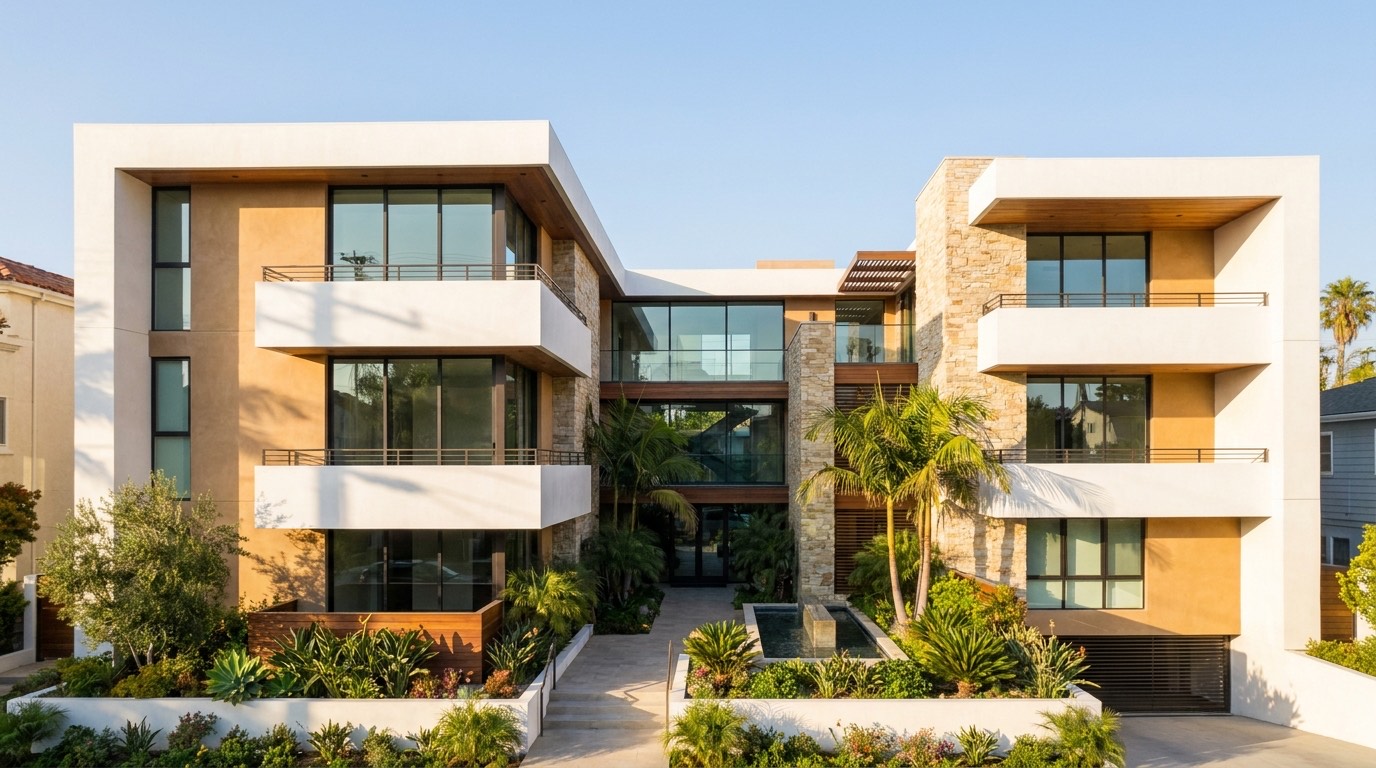
Brentwood’s condo stock is concentrated mainly along the Wilshire corridor, and it ranges from smaller older buildings to newer, more amenity-driven developments. HOA fees vary across that mix more than most buyers expect. If you’re looking at a Brentwood condo, the corridor’s mix of eras is exactly why one number can’t answer the question for you.
First, the Statewide Rules
The mechanics behind an HOA fee, what it legally has to fund, how a reserve study gets built, when a special assessment kicks in, and what a seller must disclose, don’t change because a building sits on the Wilshire corridor instead of anywhere else in California. Our HOA fees explained guide covers that ground in full. Below is what’s actually different once you’re evaluating a specific Brentwood building along that corridor.
Why the Wilshire Corridor’s Condo Stock Varies So Much
Older buildings from decades past sit alongside newer, more amenity-driven developments all along the same stretch of Wilshire, and that generational mix is exactly why the fee range here is wider than in a corridor with more uniform construction dates. A low-amenity building from an earlier era can charge a fraction of what a newer pool-and-doorman building down the block does, even on comparable units.
Older Buildings and Deferred Maintenance
Several of the older buildings along the Wilshire corridor are still working through deferred maintenance, roofs, plumbing, and structural systems that haven’t seen real updates in decades in some cases. Depending on how a specific HOA has handled it, that shows up either as a higher fee right now or as a future special assessment if the reserve hasn’t kept pace. Get the reserve study and the past couple of years of board minutes before you draw conclusions from a building’s age alone.
Seismic Retrofit Status Is Worth Checking
Los Angeles has requirements around seismic retrofitting for certain older multi-unit buildings, and it’s worth asking whether a specific building has completed that work or where it stands in the process. This isn’t something to guess at, confirm current compliance status and any related cost-sharing with the HOA board or your agent, rather than assuming a building is up to date because of its age or appearance alone.
Amenities That Push Fees Higher in This Corridor
Some of the newer condo developments along Wilshire come with amenities like a pool, gym, rooftop deck, or dedicated parking, all of which push HOA fees up compared to a smaller, no-frills building nearby. Deciding whether that’s worth it is up to you, but price out the actual monthly gap between the amenity-heavy building and the simpler one nearby before assuming the newer building wins on value.
How Brentwood Compares to Other LA Condo Markets
Buildings strung along a major commercial corridor like Wilshire tend to show a wider fee spread than a smaller, more architecturally uniform condo pocket elsewhere in LA, simply because so many different building ages and amenity levels are packed into that same stretch. It’s a pattern tied to the corridor itself rather than to any single Brentwood building, which is exactly why checking a specific building’s maintenance history and reserve planning matters more than leaning on a neighborhood average.
What a Wilshire Corridor Building Should Answer For You
Get the standard paperwork, CC&Rs, budget, reserve study, and recent minutes, then go further: ask about the building’s age, any deferred maintenance on file, and where it stands on seismic retrofit compliance if that applies. Because these buildings sit on a busy corridor, also ask how the HOA handles noise mitigation and parking, both of which shape day-to-day life here more than the fee number does.
A Wilshire corridor fee sheet rarely tells the whole story on its own. Efrat works with buyers and sellers across Los Angeles, Brentwood included, and can help you get the right documents pulled for a specific building and read them for what actually matters before you commit.
