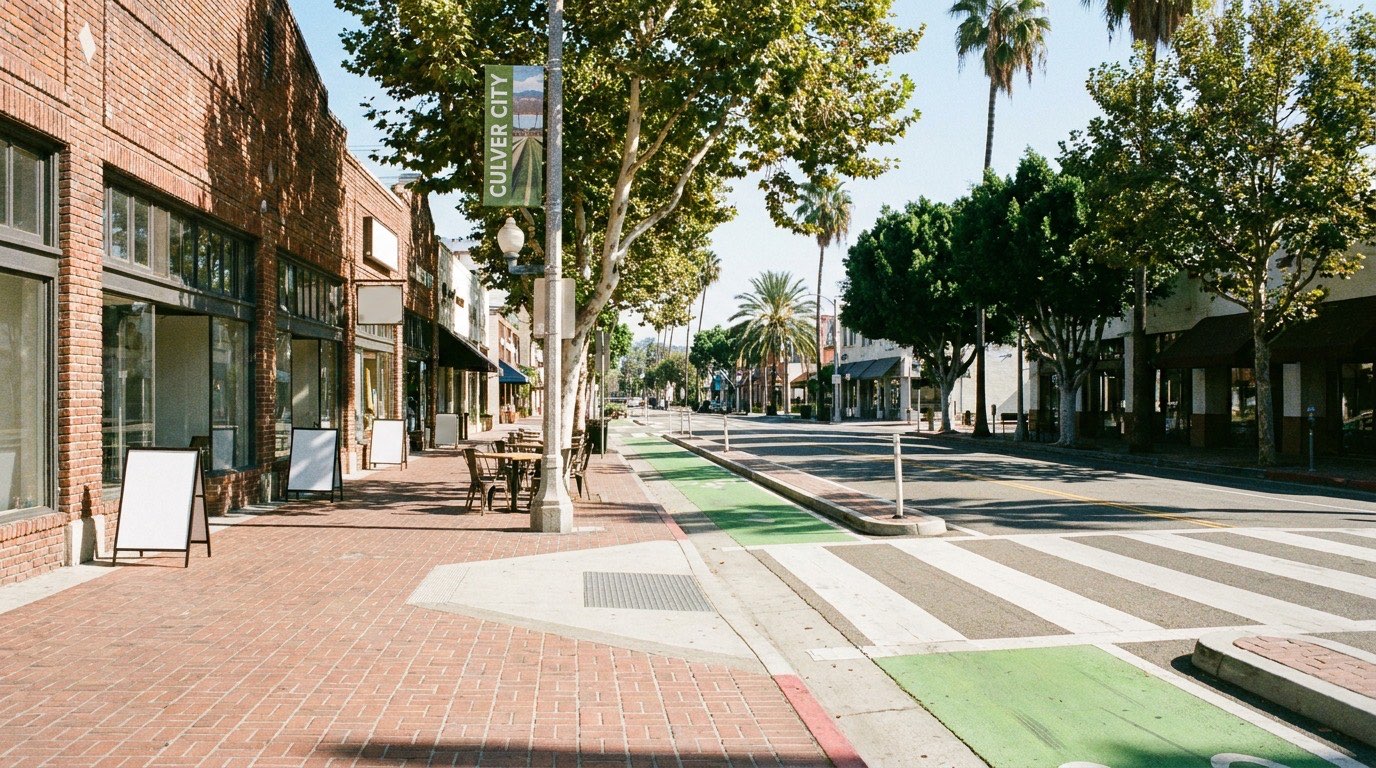
Culver City’s walkability varies more block to block than a lot of LA neighborhoods, mostly because the dense, walkable downtown core sits alongside quieter, more car-dependent residential streets. Here’s how that actually breaks down.
Downtown Culver City Is the Walkable Heart of the Neighborhood
The stretch around Main Street and Culver Boulevard, sometimes called the Culver City Arts District, is where the walkability case is strongest. Restaurants, shops, the historic Culver Hotel, and the Kirk Douglas Theatre all sit within a compact, genuinely walkable footprint, and the E Line station anchors the whole area. If daily walkability is a priority, this is the part of Culver City to focus a search on.
Residential Streets Trade Some Walkability for Quiet
Move a few blocks out from downtown, into neighborhoods like Culver West or the hillside pockets near Blair Hills, and the picture shifts toward quieter, more suburban streets that generally require a car for errands and commuting. That’s not a downside so much as a tradeoff. Buyers who want a quieter residential feel tend to prefer these areas, while buyers prioritizing walkability tend to gravitate toward downtown.
Metro’s E Line Anchors the Transit Picture
The Culver City E Line station is a genuine asset for anyone whose regular trips run toward Santa Monica or Downtown LA. It sits right in the walkable downtown core, which means residents in that area can realistically walk to the station rather than drive and park. For trips that don’t align with the line’s route, though, it’s less of a factor, and local buses fill in some but not all of the gap.
Local Bus Service Fills in the Rest
Culver CityBus and connecting Metro lines cover routes the E Line doesn’t reach, useful for shorter local trips within Culver City and to some nearby neighborhoods. Coverage and frequency vary by route and time of day, so it’s worth checking specific schedules if bus access is a real factor in a home search rather than a nice-to-have.
The Ballona Creek Bike Path Is a Real Amenity
Running along the edge of Culver City, the Ballona Creek bike path offers a mostly flat, separated route popular with commuters and recreational riders alike. It connects toward Marina del Rey in one direction and further inland in the other, and for residents whose commute or regular routes line up with it, it’s a genuine alternative to driving.
Parking Still Shapes Daily Life for Most Residents
Even in the more walkable pockets, parking availability and street parking rules matter for day-to-day life, since most trips outside the immediate downtown footprint still involve a car. It’s worth asking directly about parking, both for a specific unit and on the surrounding streets, rather than assuming walkability alone solves the parking question.
Hayden Tract Is Walkable During the Day, Quieter at Night
The Hayden Tract, home to Apple and a cluster of tech and creative offices, is walkable during business hours but functions more like a business district than a residential, around-the-clock walkable neighborhood. It’s worth keeping that distinction in mind if you’re evaluating walkability based on daytime impressions alone.
What This Means for Your Search
If walkability and transit access are a priority, downtown Culver City near Main Street and the E Line station is where that case is strongest. If you’re more focused on a quieter, residential feel and don’t mind driving for most errands, the neighborhoods further from downtown offer that at a generally different price point and pace.
Efrat serves buyers and sellers across Los Angeles, including Culver City, and can help you figure out which part of the neighborhood actually matches how you want to live day to day. Reach out to Efrat to talk through your priorities before you start touring.
