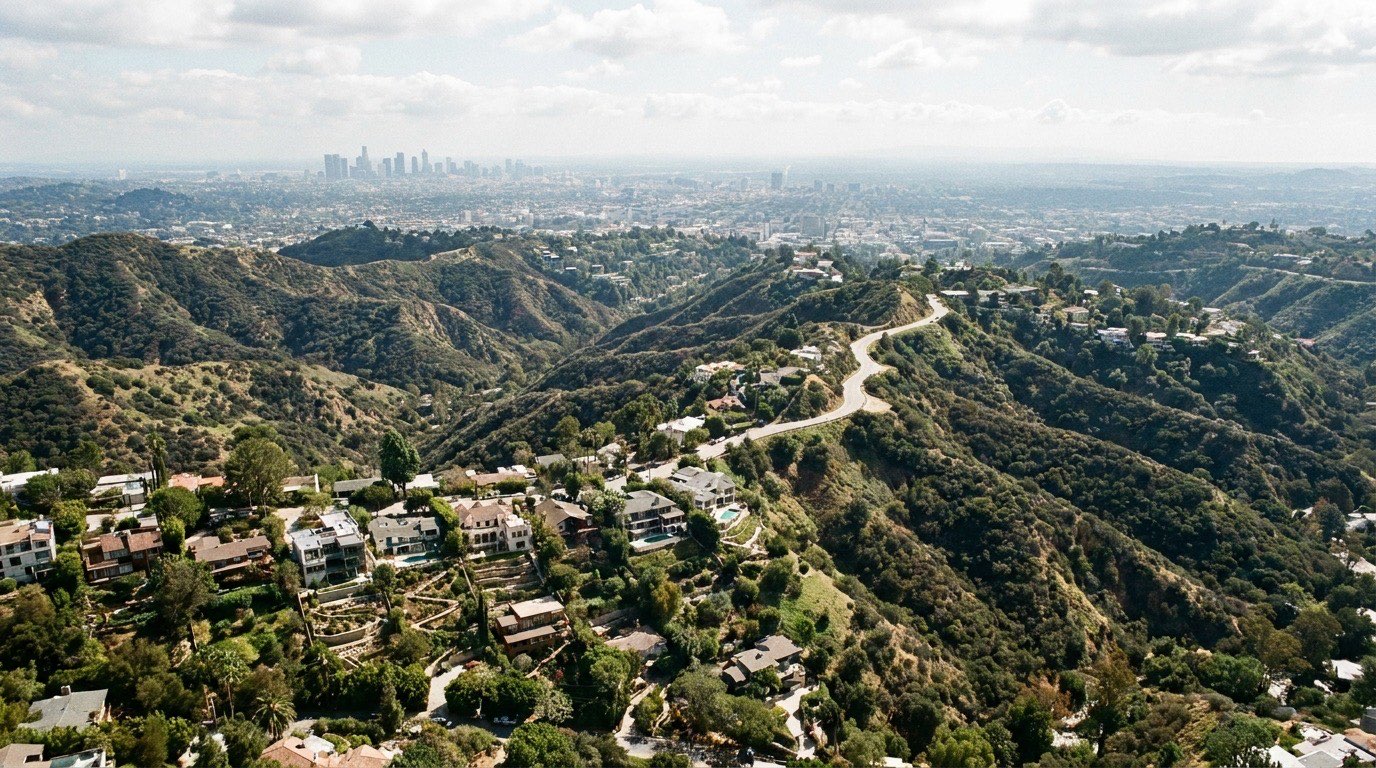
“Hollywood Hills” gets used loosely, sometimes to mean the whole hillside area above Hollywood, sometimes to mean one specific canyon. If you’re comparing listings, it helps to know where the lines actually fall and what sits inside them.
The General Footprint
The Hollywood Hills sits above the Hollywood flats, roughly starting where the flatland grid gives way to rising terrain near Franklin Avenue, and climbing up through canyon streets to Mulholland Drive along the ridge line. East to west, it spans from around the area near Griffith Park across toward the Cahuenga Pass. As with most LA hillside neighborhoods, exact boundary lines are debated locally more than they’re formally fixed, so treat any map as a general guide rather than a precise legal line.
Mulholland Drive as the Ridge Reference Point
Mulholland Drive runs along the top of the hills and is the most useful orientation point for understanding the area. Homes on or near Mulholland itself tend to sit at the higher elevations with the widest views, while streets branching down into the canyons on either side feel more enclosed and wooded. Knowing where a specific address sits relative to Mulholland tells you a lot about what kind of view and terrain to expect before you even see photos.
Laurel Canyon
Laurel Canyon is one of the most recognized sub-areas within the Hollywood Hills, known for its winding canyon road, wooded lots, and a long-standing bohemian, musical history. It reads as more rustic and enclosed than the ridge line itself, with a genuinely different feel from the more polished streets closer to Mulholland’s western stretch.
Beachwood Canyon
Beachwood Canyon sits on the eastern side, closer to Griffith Park and the hillside below the Hollywood Sign. It has a more established, tighter residential character, with some architecturally notable homes and a village-like commercial strip at its base. This is the sub-area most closely associated with the Hollywood Sign itself, though public access to the sign is restricted from this side.
Why the Sub-Areas Feel So Different From Each Other
Because the Hollywood Hills is built entirely on hillside terrain, lot shapes, elevation, and vegetation vary enormously from canyon to canyon, which is why Laurel Canyon and Beachwood Canyon don’t feel interchangeable even though both fall under the same broad neighborhood label. If you’re comparing listings across sub-areas, treat each one as its own micro-market rather than assuming “Hollywood Hills” pricing or character applies uniformly.
The Bird Streets and Other Named Pockets
Beyond Laurel Canyon and Beachwood Canyon, buyers will also hear smaller named pockets referenced informally, streets clustered near Mulholland with their own local nicknames tied to shared architecture or a particular development era. These aren’t official boundary designations, but they do get used consistently enough locally that it’s worth asking an agent familiar with the area what a given nickname actually refers to before assuming it’s marketing language.
Elevation Changes Character as Much as Location Does
Two homes with the same general “Hollywood Hills” address can sit at meaningfully different elevations, and elevation affects more than the view. Higher lots tend to get more direct sun and wind exposure and can feel more exposed to the elements, while lower canyon lots sit more sheltered and shaded, sometimes with less reliable cell reception given the surrounding terrain. Worth checking directly rather than assuming any two addresses in the same sub-area feel the same.
Confirming a Boundary Before You Offer
Boundary streets matter more than people expect. Which side of a street a home sits on can affect its school assignment, its fire risk zone, and sometimes its perceived value, even when two homes are a block apart. Before you get attached to a specific listing, confirm exactly where it falls relative to these boundary lines rather than relying on the neighborhood name in the listing description. Our guide to buying a home in the Hollywood Hills covers other hillside-specific due diligence worth doing at the same time.
Trying to figure out which canyon or sub-area actually matches what you want. Efrat serves buyers and sellers across Los Angeles, including every pocket of the Hollywood Hills, and can walk you through the practical differences street by street. Get in touch to start that conversation.
