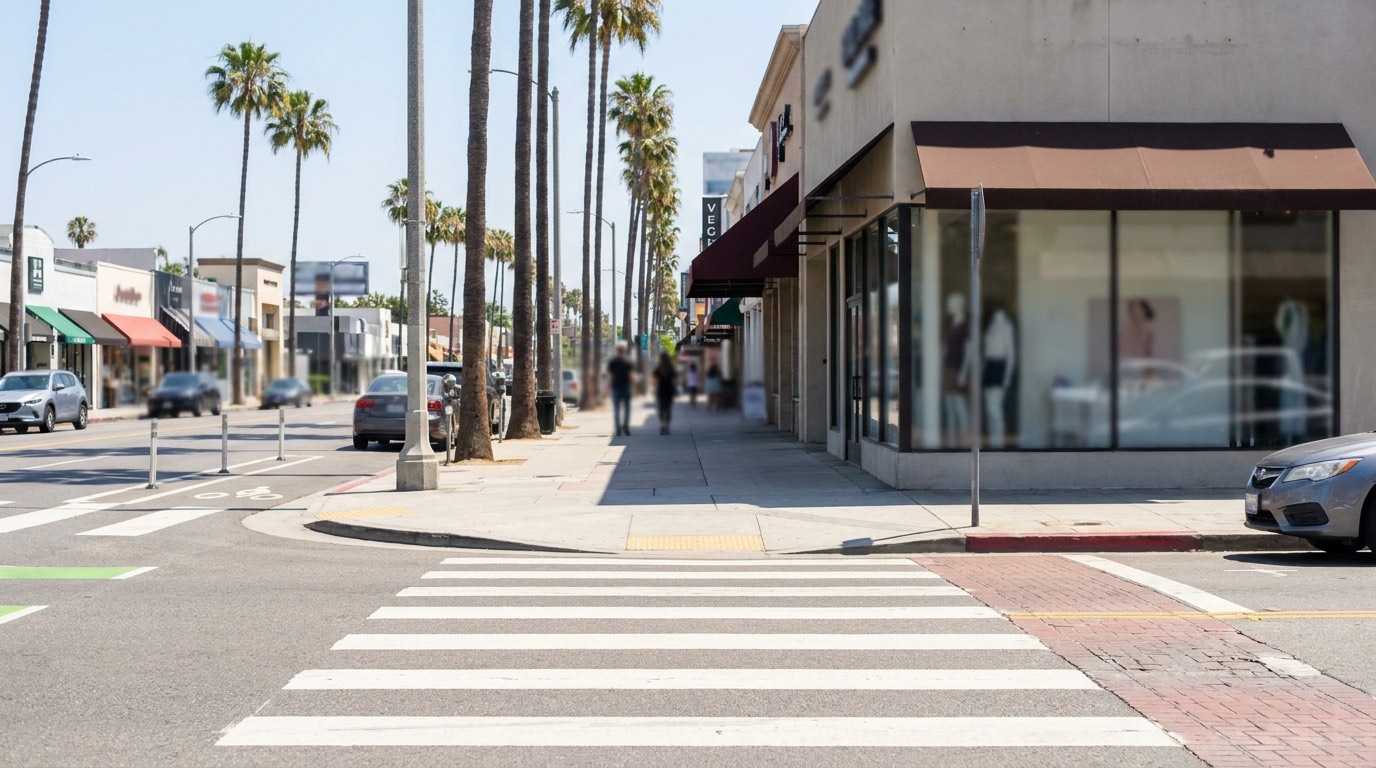
Studio City has a reputation as one of the more walkable parts of the Valley, and that reputation holds up along its main commercial spine while dropping off considerably once you move into the hills on either side. Here’s what’s realistically walkable and what still requires a car.
Ventura Boulevard Does Most of the Work
Ventura Boulevard is the walkable core of Studio City, lined with restaurants, coffee shops, boutiques, and everyday services stretching for a good stretch of the neighborhood. Streets within a few blocks of the boulevard, particularly on the flatter south side, offer a genuine walk-to-dinner or walk-to-coffee lifestyle that’s uncommon in most of the Valley. Homes further from the corridor lose that advantage quickly, so it’s worth checking actual walking distance from a specific listing rather than assuming based on the neighborhood’s general reputation.
The Hillside Pockets Are a Different Story
North of Ventura Boulevard and in pockets to the south, Studio City climbs into the hills, and those streets are a different proposition entirely. Narrow, winding roads, steep grades, and inconsistent or absent sidewalks mean walkability essentially disappears once you’re up in these areas. Residents who choose the hills are generally trading walkability for privacy, views, and a quieter setting, and it’s worth being clear-eyed about that tradeoff before assuming a Studio City address automatically means an easy walk to dinner.
What’s Realistically Walkable From a Typical Address
For homes within a few blocks of Ventura Boulevard, grocery runs, casual dining, and coffee are realistic on foot. The corridor itself is long, though, so a home near the Laurel Canyon end of Ventura can be a genuinely different walk than one near the Coldwater Canyon end, even though both technically sit on the same boulevard. It’s worth walking the actual route from a listing at the time of day you’d use it, since a map’s straight-line distance doesn’t always reflect how a street feels in practice.
Metro Bus and Rail Access
Metro bus lines run along Ventura Boulevard and connect into North Hollywood and the broader Valley bus network, which covers a fair range of local trips without a car. Metro’s B Line (Red Line) station in North Hollywood is a short drive from most of Studio City and provides a rail connection into Hollywood and Downtown. Most residents drive or get dropped off at the station rather than walking there directly, so it functions as a supplement to driving rather than a replacement for it.
Biking Works Better on the Flats Than the Hills
The flatter stretches of Studio City near Ventura Boulevard are reasonably bikeable for local errands and short trips, and it’s common to see residents bike to a coffee shop or restaurant along the corridor. The hillside streets are a different matter given the grades involved, so biking as a daily habit tends to be much more realistic for flat-area residents than hillside ones.
Parking on Ventura Boulevard
Walkable stretches near Ventura Boulevard sometimes come with tighter parking than buyers expect, particularly for older buildings without dedicated off-street spots. It’s worth confirming exactly what parking comes with a specific listing, especially if you own more than one car, since street parking along a busy commercial corridor isn’t always guaranteed.
How Studio City Compares to Nearby Walkable Pockets
Studio City’s Ventura Boulevard corridor holds up well against other walkable stretches in the Valley, though it’s worth noting it’s a linear, single-corridor kind of walkability rather than the broader, multi-directional walkable zone you’d find in a neighborhood like West Hollywood. That distinction matters if you’re comparing Studio City against other options, since a home a few blocks off the boulevard here loses walkability faster than an equivalent distance would in a neighborhood with a wider walkable core.
What to Check Before Assuming a Listing Is Walkable
Walkability in Studio City depends heavily on which side of Ventura Boulevard a home sits on and how far up into the hills it climbs. Before assuming a specific address is walkable, look at the actual route and elevation change to the businesses you’d use regularly, not just the neighborhood’s general name recognition.
If walkability is a priority in your search, reach out to Efrat and she can help you evaluate specific listings against what actually matters to you.
