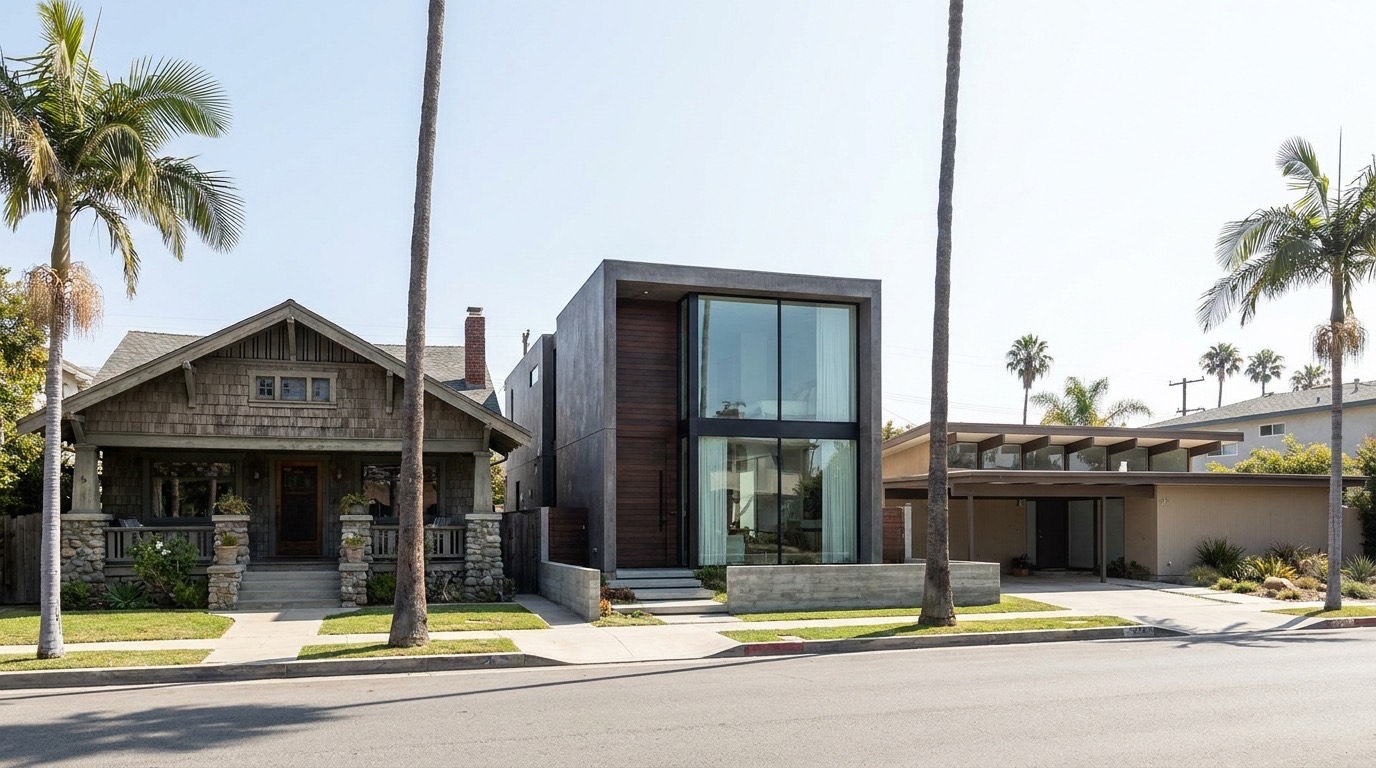
Venice’s housing stock is genuinely mixed, more so than most LA neighborhoods, and that mix is a real part of what gives the area its character. Walk a few blocks in any direction and you’ll likely pass several different eras and styles on the same street.
Original Beach Bungalows
The oldest layer of Venice’s housing stock is its original beach bungalows and small early cottages, many dating back to the neighborhood’s founding era in the early 1900s. These homes tend to be smaller, sit on modest lots, and carry real character: wood siding, front porches, a scale that feels distinctly different from newer construction. Some have been carefully preserved, others updated over the decades, and some remain largely original.
Modern Architectural Rebuilds
Venice has become a genuine draw for architect-driven modern construction over the past couple of decades. It’s common now to see a sleek, boxy contemporary rebuild sitting directly next to an original bungalow on the same block. These homes tend to emphasize clean lines, large windows, and indoor-outdoor living, a style that’s become closely associated with Venice specifically, more than with LA architecture generally. For a broader look at how this fits into the city’s architectural landscape, see our guide to architectural styles across Los Angeles.
Canal-Front Homes
Homes fronting the Venice Canals occupy a distinct category of their own. These lots tend to be narrower and more pedestrian-oriented, since the canal streets themselves are largely walkway-based rather than built around car access. Canal-front properties range from older original structures to fully modern rebuilds, but the setting itself, water views, quiet walkways, no through-traffic, is what defines this pocket more than any single architectural style.
Condos and Multi-Unit Buildings
As land in Venice has gotten scarcer and more expensive, condo and multi-unit development has grown as a real part of the housing mix, offering a different entry point than the single-family and bungalow stock the neighborhood is traditionally known for. These range from small older buildings to newer, more amenity-driven developments. If you’re weighing this option, our comparison of condos vs. single-family homes in Venice covers the practical tradeoffs.
Renovation and Rebuild Considerations
Because a good share of Venice’s demand is tied to remodeling or rebuilding older bungalows, it’s worth understanding that projects here can involve more planning steps than a straightforward inland LA renovation. Homes near the coastline or within the Venice Canals district may fall under additional review tied to coastal zone regulations, on top of standard city permitting. That doesn’t mean projects don’t get done, they do, regularly, but timelines and requirements should be confirmed with a local architect, contractor, or attorney familiar with Venice specifically rather than assumed from experience renovating elsewhere in LA.
What This Mix Means for Buyers
Because Venice’s housing stock spans so many eras and styles, often on the same block, it’s worth being specific about what you actually want rather than assuming a “Venice home” means one particular thing. A buyer set on a modern architectural rebuild and a buyer looking for an original bungalow with character are searching for genuinely different products, even within the same few blocks.
Walking the Streets Before You Decide
Photos and listing descriptions can make very different homes sound similar on paper. An original bungalow and a full rebuild might both get listed as a “3 bed, 2 bath Venice home,” even though they’re nothing alike in person. It’s worth walking a few streets before narrowing your search. Seeing how a modern rebuild actually sits next to an untouched original structure, or how a canal-front lot compares to one a block inland, tells you more in twenty minutes than a stack of listing photos will.
If you have a specific style or era in mind, reach out to Efrat. She serves buyers and sellers across Los Angeles, including Venice, and can help you narrow in on the part of the neighborhood where that style is actually concentrated.
