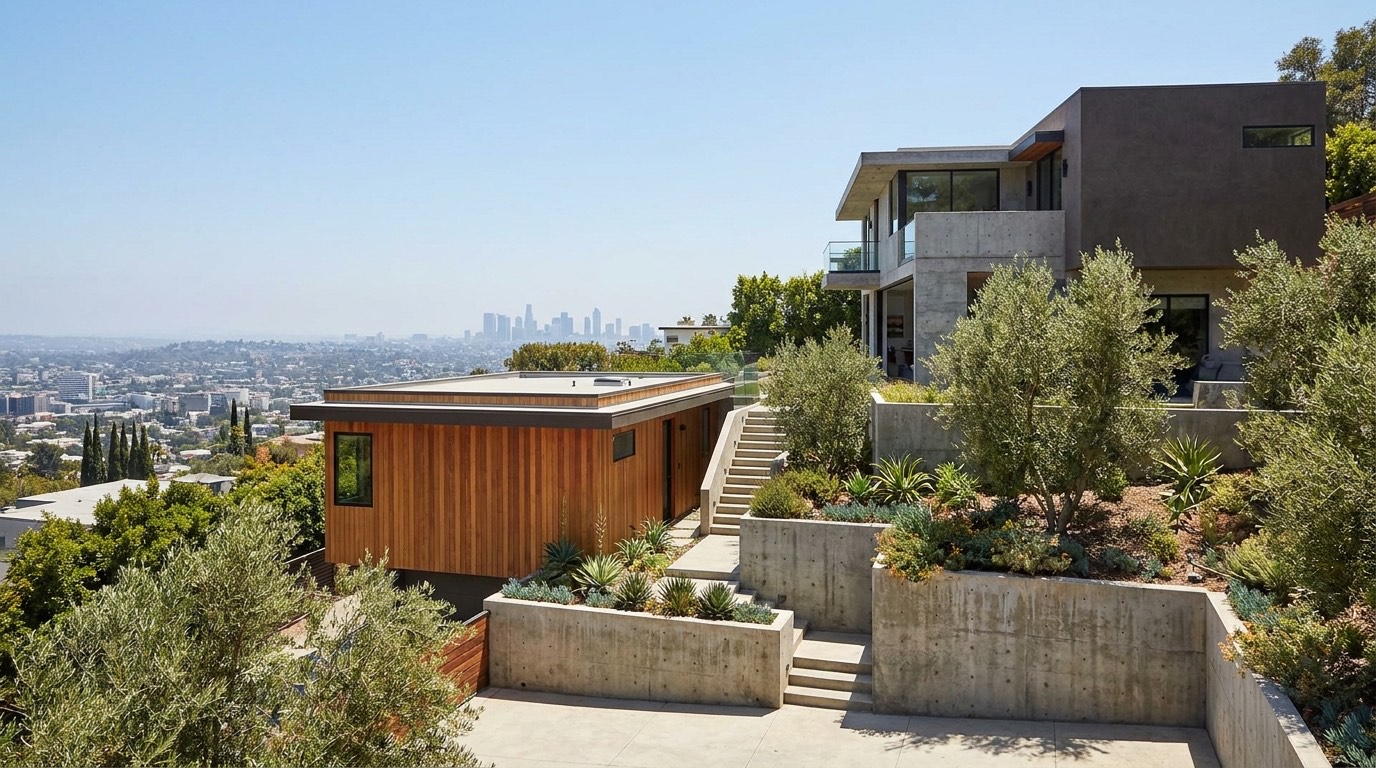
Hollywood Hills is overwhelmingly single-family and hillside terrain, so ADU and multi-family potential here works differently than in a flatland LA neighborhood.
Hillside Terrain Changes the Construction Math
Building on a slope costs more than building on flat ground, full stop. Grading, retaining walls, and equipment access all add expense to an ADU project compared to a flatland lot, and permitting can take longer where the city requires soils or slope stability reports. None of that rules out an ADU, but it changes the budget and timeline you should plan for. Our hillside estates guide covers the broader version of these same construction realities.
Access Is the First Thing to Evaluate
Before pricing out an ADU, walk the actual access point for construction equipment and materials. Narrow, winding streets and steep driveways common in the Hollywood Hills can limit what equipment can reach the site, which affects both cost and the realistic scope of what’s buildable. This is worth confirming with a contractor early, before you’ve invested in full plans.
View Corridor Is the Real Opportunity
Where a hillside ADU can genuinely outperform a flatland one is view value. If the ADU can be sited to capture the same view corridor as the main house, it can command rents or resale value well above a typical accessory unit. That takes deliberate design, since a poorly placed unit that loses the view advantage won’t see the same premium. Anyone chasing view-driven value on a hillside lot should treat ADU siting as a design priority, not an afterthought.
Multi-Family Conversion Is Less Common Here
Because Hollywood Hills has essentially no condo stock and lot sizes and access are constrained by terrain, larger multi-family conversions are less typical here than in denser flatland neighborhoods. Most additional-unit potential in the Hollywood Hills shows up as a single ADU rather than a multi-unit build-out, and that’s worth knowing before you assume a hillside lot behaves like a flatland one for density purposes. Where a lot is large enough and access allows it, a second, smaller detached ADU beyond the first is sometimes possible under current state law, but it deserves the same site-specific evaluation as a first unit rather than an assumption that it will fit.
Weigh the Rental Case Before You Build
An ADU only pencils out if the rental economics support the added construction cost. Given how the broader Hollywood Hills rental market skews toward tenants specifically seeking privacy and a view, a well-sited ADU with its own outlook can command a real premium over a generic accessory unit, but a unit tucked behind the main house with no view or privacy advantage may not justify the added hillside construction expense. Run the numbers on realistic rent for the specific unit design before committing to full plans.
Zoning and Local Rules Still Apply
California’s statewide ADU laws set a baseline, but local zoning, hillside-specific ordinances, and site conditions like slope and lot coverage still determine what’s actually buildable on a given parcel. Check current requirements with the city and a qualified contractor before assuming a standard ADU plan transfers directly to a hillside lot.
Is It Worth Pursuing on Your Property
If you have a lot with usable buildable area and a construction-accessible site, an ADU can add real rental or resale value in the Hollywood Hills, particularly if it can share in the property’s view. If access or slope severely limits the buildable footprint, it’s worth getting a contractor’s read before you invest in full architectural plans.
Considering ADU potential on a Hollywood Hills property. Efrat serves buyers, sellers, and investors across Los Angeles, including the Hollywood Hills, and can help you think through what a specific lot supports. Get in touch to talk it through.
