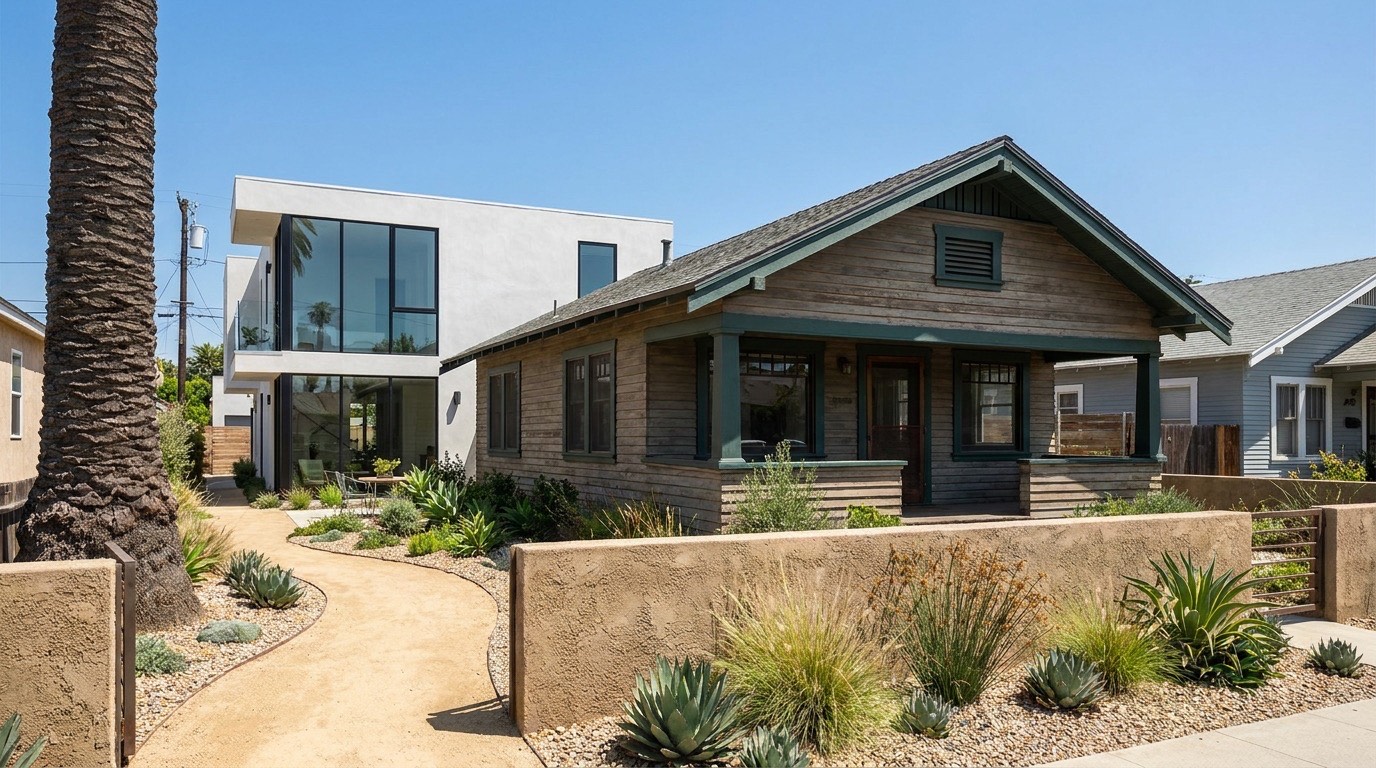
Venice’s ADU and multi-family potential looks different from a typical inland LA lot, mostly because of lot geometry and coastal-zone overlay. For the general mechanics of ADUs in Los Angeles, size limits, permitted use, standard permitting timelines, see our broader guide to homes with ADU potential in LA. This post focuses on what’s specifically different in Venice.
Lot Size and Shape Vary More Than People Expect
Venice’s housing stock includes a lot of narrow original beach bungalow lots, alongside some larger assembled parcels, and that variation matters directly for ADU feasibility. A narrow lot with an existing structure close to setback lines may have real constraints on where a detached ADU can go, while a wider or deeper lot in the same neighborhood might have plenty of room. Don’t assume ADU feasibility from Venice’s general reputation, check the specific lot dimensions and existing structure footprint.
Coastal Zone Status Can Add a Permitting Layer
Because parts of Venice fall within the California Coastal Zone, ADU permitting on those parcels can involve Coastal Commission review in addition to the standard city ADU process. That doesn’t mean an ADU isn’t achievable, but it can mean a longer timeline and additional documentation compared to an equivalent project on an inland lot. Confirm coastal zone status for a specific address before you build a renovation or investment plan around a fast ADU timeline.
Some Lots Carry Real Multi-Family Potential
Beyond a single ADU, some Venice parcels carry zoning that supports small multi-family development, more than one additional unit, not just a standalone ADU. This is genuinely worth exploring if you’re looking at Venice from an investment angle, since it changes the math significantly compared to a single-family-plus-ADU plan. It’s parcel-specific, though, so pull the actual zoning designation rather than assuming based on a neighboring property.
Existing Structure Placement Constrains Options Too
Beyond raw lot size, where the existing home sits on the lot matters just as much for ADU feasibility. A house built close to the rear or side property lines on a narrow Venice lot leaves less usable space for a detached unit, and may push the conversation toward an attached or garage-conversion ADU instead. It’s also worth confirming that any existing addition on the lot was actually permitted, since unpermitted square footage can complicate how much of that footprint you can actually count on. This is another reason a general answer about Venice’s ADU potential can’t substitute for looking at the actual footprint of the property you’re considering.
How This Plays Into an Investment Decision
Adding rentable square footage, whether an ADU or additional units, changes the return profile on a Venice property meaningfully, since land here already carries a premium and added density helps justify that cost. If you’re weighing a value-add strategy that includes ADU or multi-family potential, our comparison of turnkey vs. value-add investment properties in Venice covers how that fits into a broader investment approach, and our take on Venice as an investment overall covers the appreciation and risk side of the equation.
Confirm the Specifics Before You Commit
ADU and multi-family potential in Venice is genuinely parcel-specific in a way that a general neighborhood description can’t settle. Lot dimensions, coastal zone status, and current zoning designation all need direct confirmation for the property you’re actually considering, not an assumption carried over from a similar-looking lot down the street.
Working with an architect or contractor who has actually pulled permits in Venice recently, rather than one only familiar with inland LA projects, can also save real time given how much the coastal review layer varies parcel by parcel.
If you’re evaluating a Venice property for its ADU or multi-family potential, reach out to Efrat. She serves buyers and sellers across Los Angeles, including Venice, and can help you figure out what a specific lot can realistically support before you invest in plans or permitting.
