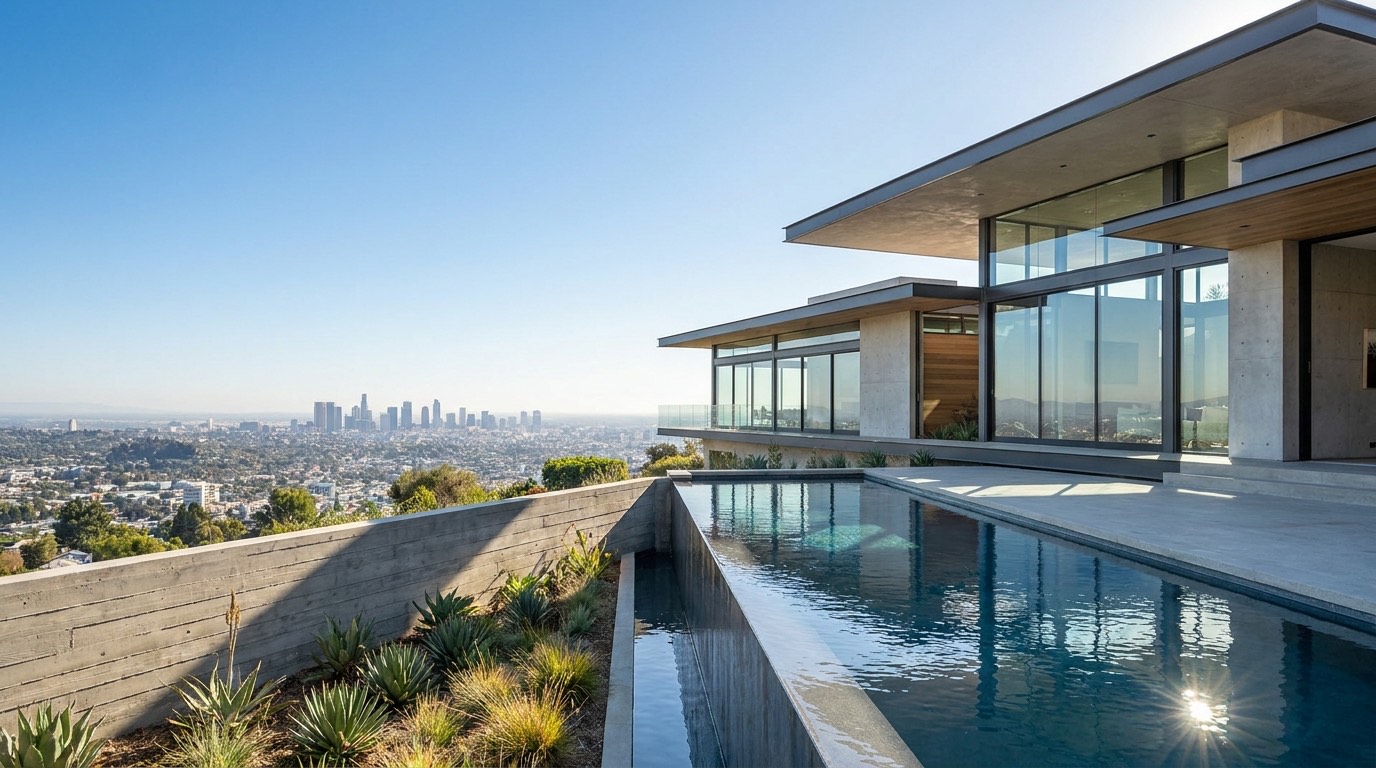
Buying in the Hollywood Hills isn’t just buying a home in a different neighborhood, it’s buying into a market that prices and moves differently from most of Los Angeles. Here’s what to actually expect.
Pricing Follows the View, Not the Square Footage
In most LA neighborhoods, price per square foot is a useful comparison tool. Here, it’s a much blunter one. View quality, privacy, and lot uniqueness drive pricing far more than raw square footage, which means a smaller home with a commanding view can outprice a larger home without one. Comps require more judgment here than a simple per-square-foot comparison, and it’s worth working with someone who can read the nuance in a specific street rather than relying on averages alone.
There’s No Condo Alternative
Unlike neighborhoods such as West Hollywood or the Hollywood flats, there’s essentially no condo inventory in the Hollywood Hills proper. If a low-maintenance condo lifestyle is part of your plan, this isn’t the submarket for it, and it’s worth deciding early whether you’re genuinely committed to single-family hillside living before you spend time touring here.
Every Canyon Community Is Its Own Micro-Market
Laurel Canyon, Beachwood Canyon, and the ridge along Mulholland Drive each carry a distinct character and, often, a distinct price positioning. A strong comp in one canyon doesn’t necessarily tell you much about pricing in another, so it’s worth treating your search as a comparison across several micro-markets rather than one unified Hollywood Hills market.
Off-Market Activity Is More Common Here
Higher-end and unusually private properties in this submarket change hands off-market more often than typical LA listings, partly because sellers here tend to value discretion and partly because the buyer pool for a specific kind of view or lot can be small and well known within the local agent network. Having genuine relationships in this specific submarket, not just general LA market access, matters more here than in a broad, deep neighborhood with hundreds of comparable listings.
Financing Skews Toward Jumbo Loans
Given the price points typical of view properties here, financing more often falls into jumbo loan territory than a standard conforming mortgage. If you haven’t already gone through mortgage pre-approval with a lender experienced in jumbo lending, it’s worth doing that early, since underwriting timelines and requirements can differ from a conventional loan.
Inspections Go Beyond the Usual Checklist
Hillside properties carry their own set of structural and access questions, geological reports, retaining wall history, drainage, and fire insurance availability, that a standard home inspection checklist doesn’t fully cover. Our guide to buying a hillside home in Hollywood goes deep on these specific risks and what to check before you remove contingencies, and it’s worth reading in full before you’re deep into escrow on a hillside address.
Build in Extra Time, Not Necessarily More Stress
None of this means buying here is harder in a bad way, it just means the process has a few more specialized steps than a flatland purchase. Planning for a slightly longer contingency period to accommodate a specialist inspection or an insurance quote tends to prevent surprises rather than create them.
Comparing an Offer Against Others in This Market
Because inventory can be thinner in a specific canyon at any given time, and because so much of the value sits in intangibles like view and privacy, what makes an offer stand out elsewhere in LA still applies here, but sellers in this submarket often weigh a clean, well-financed offer even more heavily given how much they’ve invested in a property that may have taken years to find the right buyer for.
If you’re seriously considering a purchase in the Hollywood Hills, Efrat serves buyers and sellers across Los Angeles, including the canyon communities here, and can help you navigate the parts of this process that are genuinely different from a typical LA purchase. Get in touch to talk it through.
