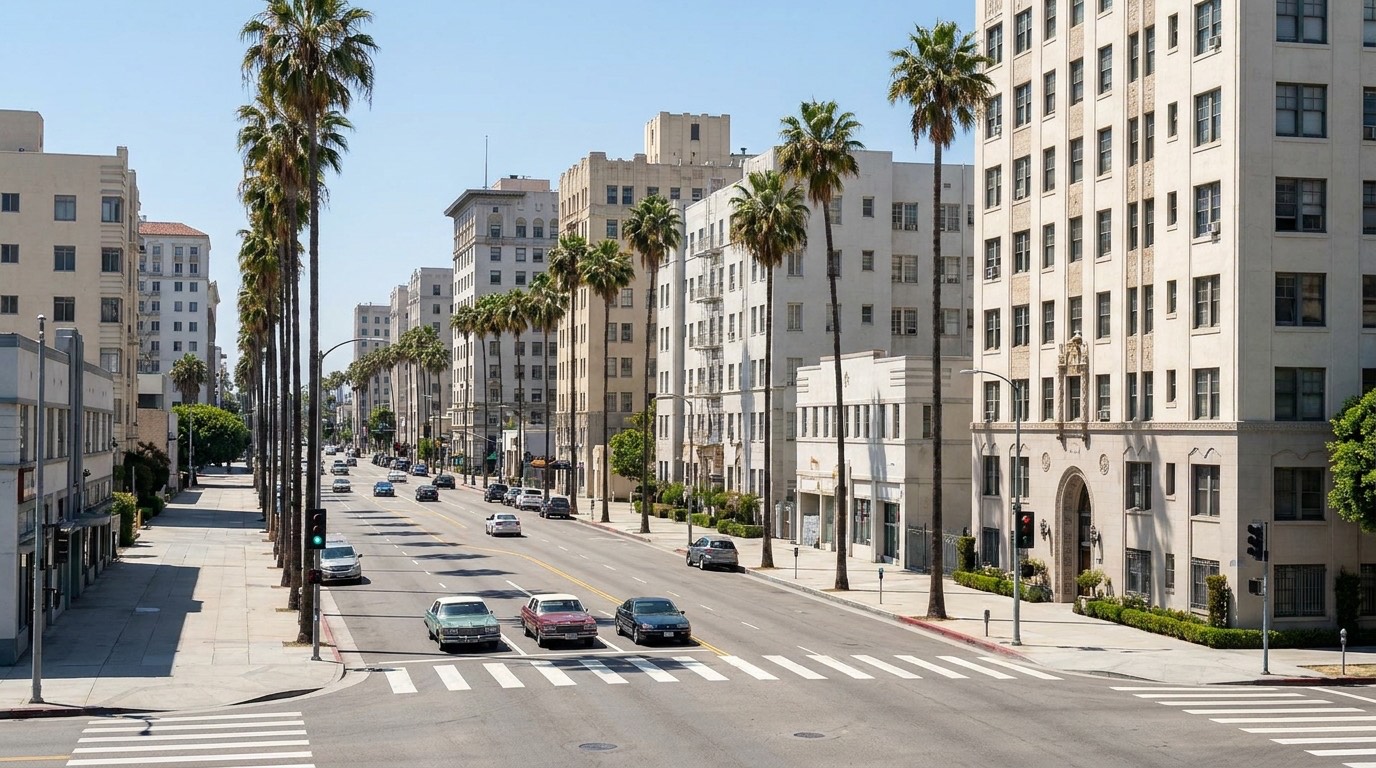
Mid Wilshire and Westwood both sit in the broader Los Angeles core, but they were built around entirely different anchors, one around a concentration of museums along a historic apartment corridor, the other around a major university, and that difference shapes almost everything else about how the two neighborhoods compare.
The Anchoring Institution Is the Core Difference
Mid Wilshire’s identity centers on Museum Row, LACMA, the Petersen Automotive Museum, the Academy Museum of Motion Pictures, and the La Brea Tar Pits, all within a genuinely walkable stretch. Westwood’s identity centers on UCLA, a major research university whose academic calendar shapes foot traffic, seasonal rhythm, and a large share of the neighborhood’s renter demand. Neither institution is going anywhere, but they create very different daily textures, museum-going and cultural access in one case, campus energy and academic-year cycles in the other.
Housing Stock Runs Along Different Lines
Mid Wilshire developed largely as a corridor of prewar and mid-century apartment buildings with a growing layer of condo product, and single-family homes are the exception rather than the rule. Westwood offers more genuine range: Wilshire Corridor high-rise condos, older single-family homes tracing back to the late 1920s, and streets closer to Holmby Hills with a more established, luxury-adjacent character. If housing type variety matters to your search, Westwood currently offers more of it within one neighborhood.
Transit Access Currently Favors Mid Wilshire
The Metro D Line extension has already brought subway stations directly into the Mid Wilshire corridor, giving it a rail connection to Koreatown, Downtown, and points beyond that didn’t exist a few years ago. Westwood’s own station on the same line is part of a later project phase, so its direct subway access is still catching up. For a buyer prioritizing car-free or reduced-car commuting today, Mid Wilshire currently has the more immediate advantage.
The Renter Base Looks Different in Each Neighborhood
Westwood’s renter pool is heavily shaped by UCLA, students, staff, and people drawn by proximity to the university and medical center, with real seasonal turnover tied to the academic calendar. Mid Wilshire’s renter base is more varied and less tied to a single institution: museum and entertainment-industry workers, professionals who want a central location, and residents drawn by the walk to Larchmont Village. If you’re evaluating either as a rental investment, our Mid Wilshire rental market overview and Westwood’s own rental market overview lay out each renter base in more depth.
Rent Stabilization Shows Up in Both, Differently
Both neighborhoods have real pockets of older housing stock covered by the City of Los Angeles rent stabilization ordinance, but the practical effect differs. In Mid Wilshire, it applies across a large share of the historic apartment corridor that defines the neighborhood. In Westwood, it’s more concentrated in specific older buildings within a broader mix of newer, uncovered condo product. Confirm coverage on the specific building in either case rather than assuming based on the neighborhood.
Walkability Depends on Which Pocket You’re Comparing
Mid Wilshire’s walkability concentrates around Museum Row and the Wilshire corridor itself, strongest right along the boulevard and thinning out on the residential side streets. Westwood’s walkability concentrates around Westwood Village and campus, with a similar drop-off toward its quieter residential streets. Neither neighborhood is uniformly walkable end to end, so compare the specific pocket you’re considering in each, not the neighborhood’s reputation as a whole. Our best streets overview for Mid Wilshire and Westwood’s best streets overview both break this down pocket by pocket.
Which One Fits You Better
If museums, cultural institutions, and a growing transit advantage matter most to your daily life, Mid Wilshire is the stronger fit. If campus energy, academic-community life, or proximity to UCLA’s resources and the Westside matter more, Westwood is built specifically around that. Both are legitimate, distinct answers to “what does central or west LA living look like,” not a better-or-worse pair.
If you’re weighing Mid Wilshire against Westwood for your own purchase, reach out to Efrat. She serves buyers and sellers across Los Angeles, including both neighborhoods, and can help you think through which one actually fits what you’re looking for.
